Solar shading · Types
Stopping the sun outside the glass: four types of solar shading
This article is compiled from official statistics, regulations, standards and industry publications; sources are listed at the end.
- Solar shading cuts direct sunlight on the facade outside the glass, which prevents overheating and glare indoors.
- Fixed louvres set horizontally on a south facade block the high summer sun and let the low winter sun in.
- With adjustable louvres and external venetian blinds, the slat angle is used to balance shade against daylight.
- A zip screen filters sun and heat without fully closing off the view and offers high wind resistance.
The basic difference between external solar shading and an internal blind is where the shade forms. When it forms outside the glass, most of the heat never enters the building. That difference matters more as cooling needs grow: according to the EU’s Joint Research Centre, 26% of households in the EU cannot keep their homes comfortably cool in summer [1]. This article covers the four main types, how their performance is measured, what research shows and what to check when choosing.
Four types of external shading
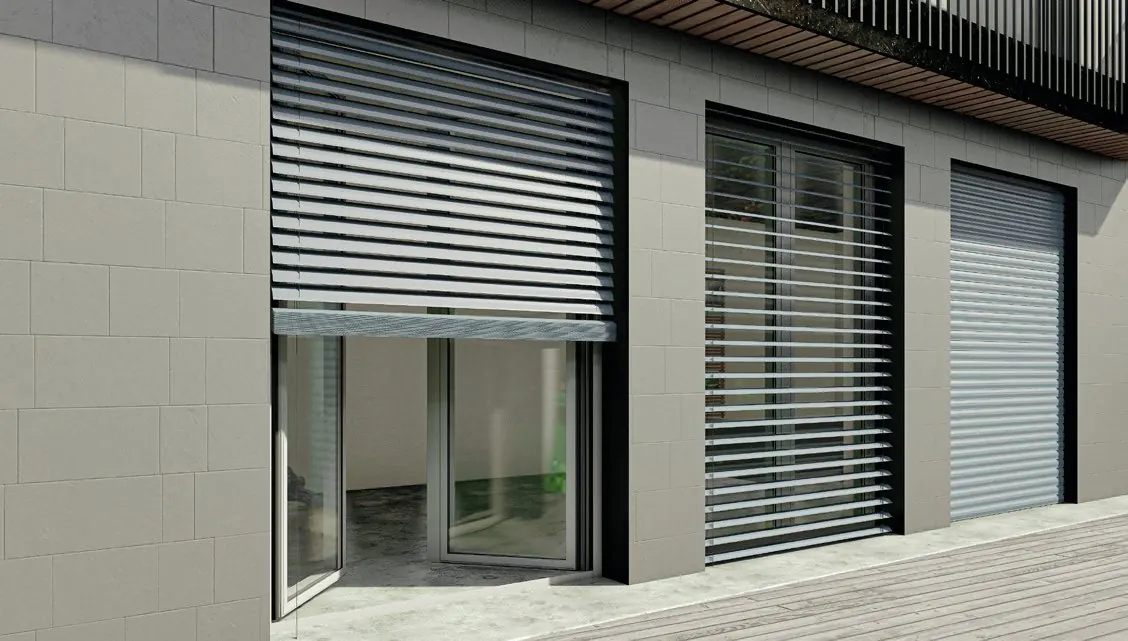
Fixed louvres are installed at a set angle and need no maintenance. Placed horizontally on south facades, they cut out the summer sun while admitting the winter sun. Adjustable louvres are turned by hand or by motor so that shade and daylight can be balanced as the sun moves; in Ferrini’s Orient system, fixed and movable louvre profiles are combined.
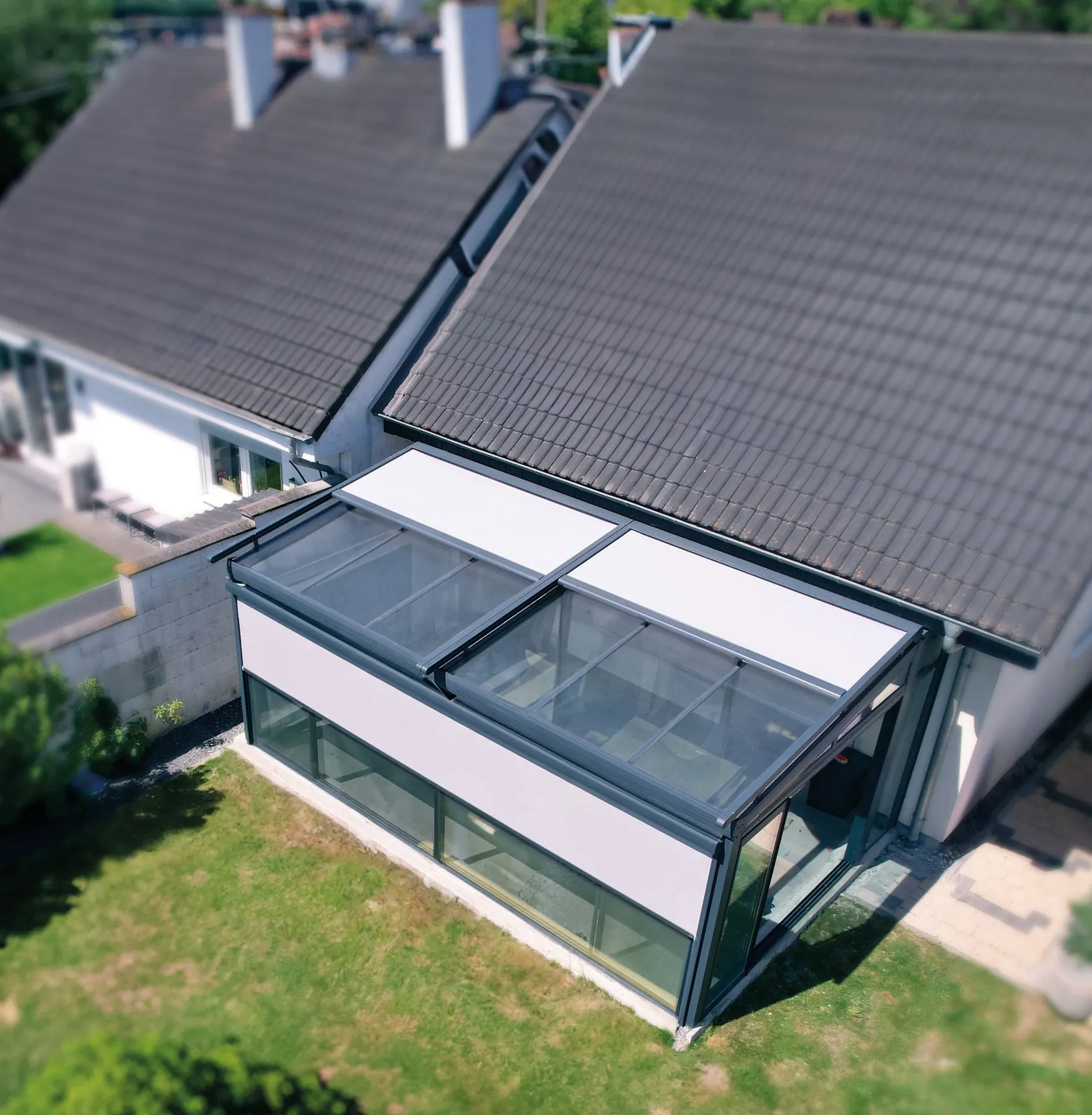
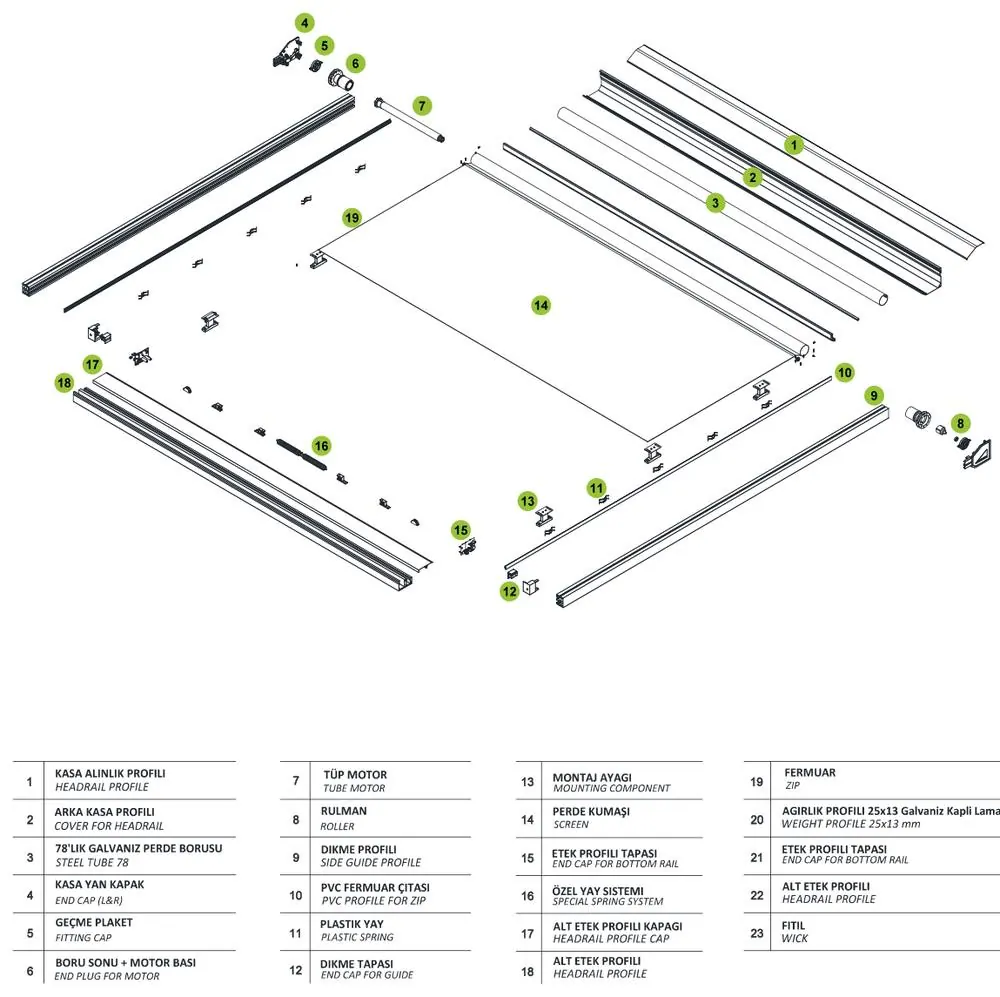
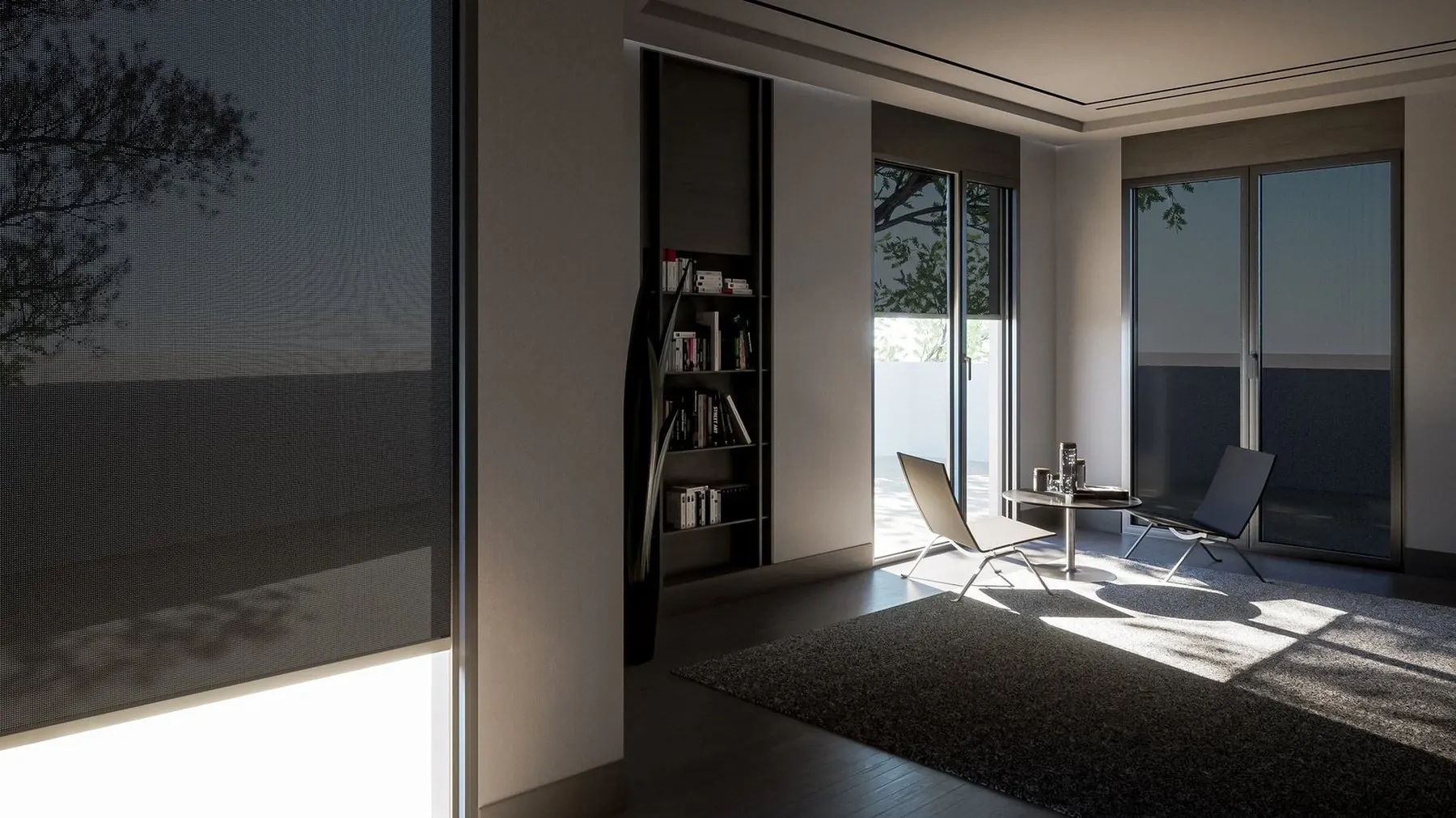
External venetian blinds, also known as raffstores, are made of aluminium slats that can be closed completely, raised or tilted, and are common in offices and homes. Textile shading in the form of the zip screen locks the fabric into guide rails: it filters sun and heat while keeping a view outside, and it stands up well to wind.
How performance is measured
The thermal effect of a shading product is expressed as g tot, the share of total solar energy that passes into the building through the glass and the shading device together. EN 14501 classifies this value; the lower it is, the less solar heat enters [2]. The same standard also classifies visual comfort properties such as glare control, visual contact with the outside and use of daylight [2], so an assessment considers light and view as well as shade.
Fabric colour shows how much position matters. A sector guide based on EN 14501 gives g tot values of 0.08 for dark grey and 0.11 for white fabric used externally, while the result is reversed for internal blinds; dark colours outside are therefore no drawback for solar control [3].
What research shows
In a simulation for a house in Athens by the European Solar-Shading Organization (ES-SO), external venetian blinds reduced cooling demand by 21% when operated manually and by 39% when automated [4]. A study of an office building in Antalya, on the Mediterranean coast, examined 1,485 scenarios; the fixed external shading solutions that stood out reduced cooling energy by 37–49% with high-performance glazing and by 73–78% with low-performance glazing [5].
The results suggest that automatic control can increase savings and that the contribution of shading depends on the glazing [4, 5]. As they are based on simulations and single-building studies, they should be read as indicative findings rather than expected savings.
What to check when choosing
The first decision depends on orientation. On south facades the summer sun is high at midday, so horizontal louvres work well. On east and west facades the sun arrives at a low, almost horizontal angle, and vertical louvres, adjustable systems or zip screens are more effective. North facades receive little direct sun, so daylight is the priority there.
The second is documented performance. Requirements for shutters and external venetian blinds are set out in EN 13659, and for external blinds such as zip screens in EN 13561 [6]; wind load tests follow EN 1932 [7]. Compare the wind class each manufacturer declares rather than Beaufort figures, whose conversion varies between manufacturers [8].
Frequently asked questions
How do European rules treat solar shading?
About two-thirds of European countries use the g tot value from EN 14501 in their national energy calculations, so solar control can be reflected in a building’s official energy performance [9]. Rules are also starting to measure summer comfort directly: the UK’s Approved Document O limits summer solar gain in new homes [10], and France’s RE2020 assesses summer comfort in degree-hours without counting air conditioning [11].
Where does the information on this page come from?
From external sources rather than Ferrini’s production records. Performance definitions come from European standards [2, 6, 7], energy effects from a sector organisation’s simulation and an academic study [4, 5], and policy context from EU and national sources [1, 9, 10, 11]. Ferrini’s own production data on solar shading products are presented separately in its report.
Sources
- European Commission Joint Research Centre (JRC), Addressing Residential Cooling Demand and Summer Energy Poverty in the EU – Towards a Cooler Future (JRC143288), 23.01.2026. https://publications.jrc.ec.europa.eu/repository/handle/JRC143288
- CEN, EN 14501:2021 Blinds and shutters – Thermal and visual comfort – Performance characteristics and classification (consolidated version EN 14501:2021+A1:2025), March 2021; 2025. https://iteh.es/catalog/standards/cen/8b0257b8-f10b-4994-ae49-2493d6cd12ab/en-14501-2021
- ES-SO / Solskyddsförbundet, Solar shading for low energy buildings (with EN 14501 classification), 2012 (industry association publication). https://www.solskyddsforbundet.se/wp-content/uploads/2019/12/Solar-shading-for-low-energy-buildings.pdf
- ES-SO (European Solar-Shading Organisation) Technical Committee, Conventional control strategies for shading devices in residential and office premises, March 2025 (industry association publication). https://es-so.com/onewebmedia/news/Control%20Strategies%20for%20shading%20devices.pdf
- Koç, S. G. and Maçka Kalfa, S., The effects of shading devices on office building energy performance in Mediterranean climate regions, Journal of Building Engineering 44, 102653, 2021, DOI 10.1016/j.jobe.2021.102653. https://www.sciencedirect.com/science/article/abs/pii/S2352710221005118
- CEN (European Committee for Standardization), CEN/TC 33, EN 13561:2015 External blinds and awnings; EN 13659:2015 Shutters and external venetian blinds – Performance requirements including safety, August 2015 (catalogue records). https://iteh.es/catalog/standards/cen/49186b1d-7c1a-4bbc-9a04-f83572642c33/en-13659-2015
- CEN / Estonian Centre for Standardisation; Swiss Association for Standardization, EN 12045:2000 Power operated blinds and shutters – Safety in use; EN 1932:2013 External blinds and shutters – Resistance to wind loads, catalogue records, accessed 02.10.2026. https://www.evs.ee/en/evs-en-12045-2000
- BauNetz Wissen Sonnenschutz (Heinze GmbH), Windwiderstandsklassen, undated page, accessed 02.10.2026. https://www.baunetzwissen.de/sonnenschutz/fachwissen/bauphysik/windwiderstandsklassen-10299092
- Van Eycken, A. (ES-SO), Solar and daylight management for energy performance of buildings, REHVA Journal 04/2015, s. 26–27. https://rehva.eu/rehva-journal/chapter/solar-and-daylight-management-for-energy-performance-buildings
- GOV.UK (DLUHC), Overheating: Approved Document O, 15 December 2021; updated 15 June 2022, accessed 02.10.2026. https://www.gov.uk/government/publications/overheating-approved-document-o
- Fédération Française du Bâtiment, RE 2020 : confort d'été et indicateur DH, undated, accessed 02.10.2026. https://www.ffbatiment.fr/techniques-batiment/reglementation-construction/reglementation-thermique-environnementale/dossier/re2020-confort-d-ete-et-indicateur-dh