Zip screens · Components
Cassette, side channels and bottom bar: how a zip screen works
This article is based on Ferrini’s 2015–2026 production records; figures are given as shares and indices only.
- In a zip screen, both edges of the fabric are held inside the side channels by a zip-like strip.
- This keeps the fabric taut in the wind and limits the light and insects passing at the edges.
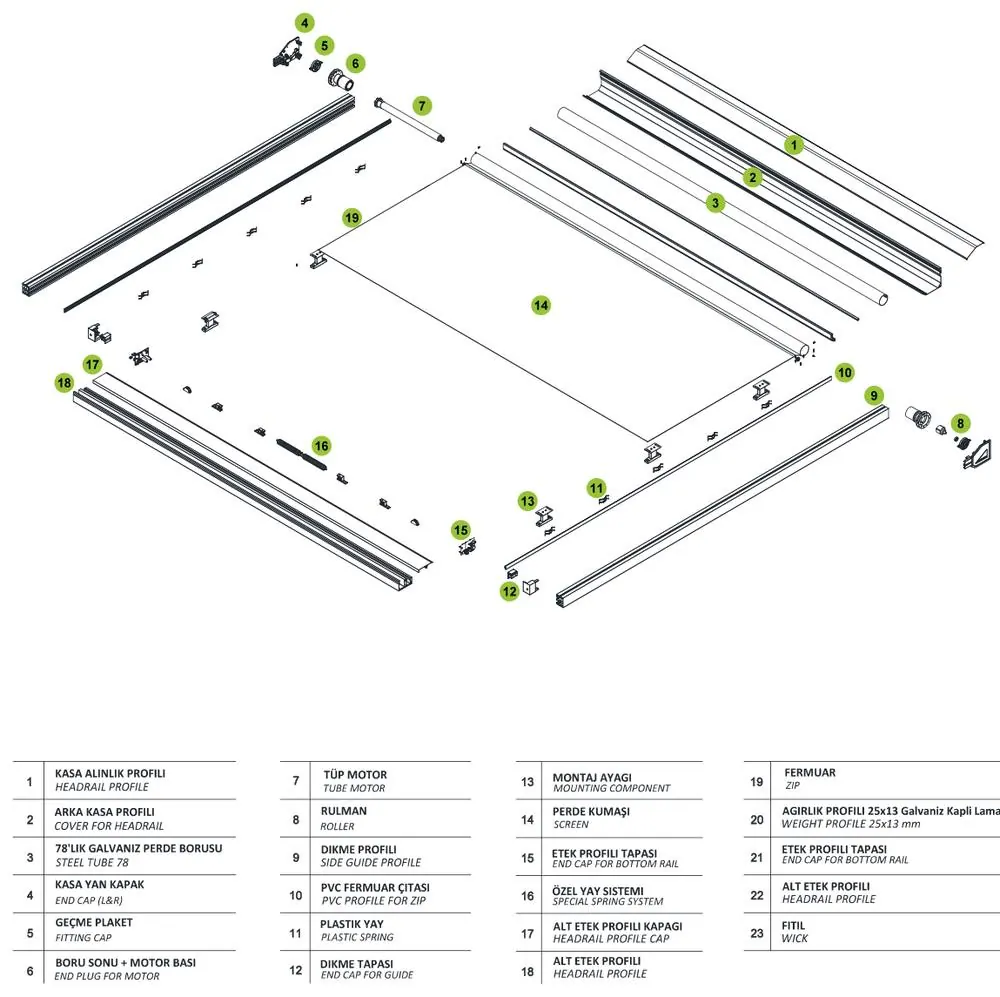
- The fabric winds onto a tube inside the cassette, and the bottom bar holds it under tension.
- In 2023–2025 about 95% of Ferrini’s zip screen units were vertical screens and about 5% roof screens.
What sets a zip screen apart from an ordinary external blind is that the fabric is locked into the side channels along its full height. Its wind resistance and its appearance therefore depend largely on how three components work together: the cassette at the top, the side channels and the bottom bar. This article goes through those parts and the series in Ferrini’s catalogue, then looks at facade integration, fabric, and the European rules that specifiers and importers will meet. Series names and technical drawings come from Ferrini’s product catalogue.
Questions about zip screens? Ferrini’s team will be glad to help: +90 232 864 22 20.
Three components, one system
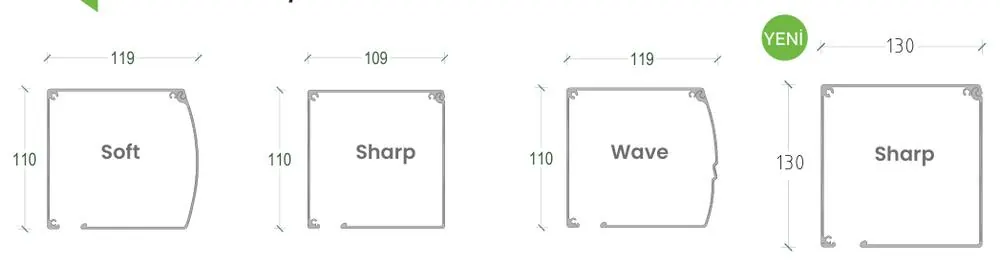
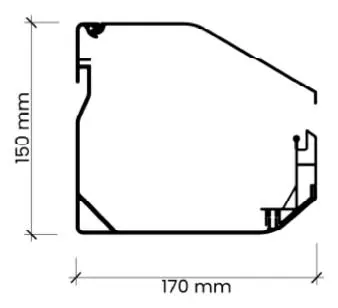
The cassette houses the roller tube onto which the fabric winds; Ferrini’s catalogue offers it in round, square and wave-shaped forms. The side channels receive the zip-like strip that runs along each edge of the fabric, so the fabric cannot be pulled out sideways when the wind presses on it. At the bottom, the bottom bar keeps the fabric taut.
Because the edges are closed along their whole length, the same construction also limits the light and insects that pass at the sides. For the vertical Neo series, the catalogue shows separate sections for the side channel and the bottom bar. The Sky-S roof series has its own side channel, bottom bar and cassette sections, plus mounting brackets.
Two series, several configurations
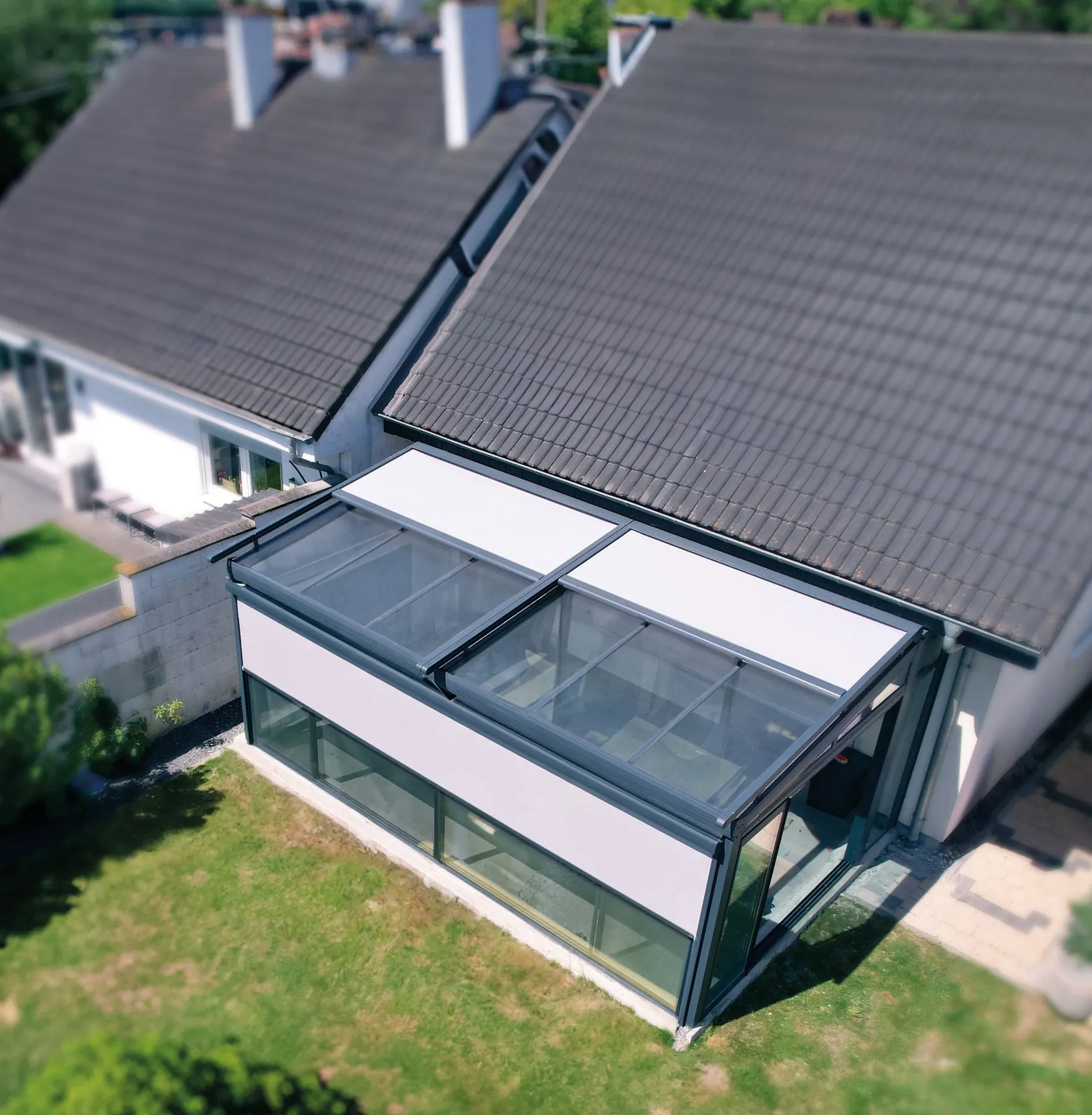
Ferrini’s catalogue has two main series. Neo is the vertical zip screen used on facades, in front of windows and glass walls. Sky-S is the roof zip screen, fitted horizontally or at a slope on terrace and winter garden roofs.
The models shown at Fensterbau Frontale 2026 illustrate how the same anatomy is varied: the Zipline Neo 110 Sharp in a solar-panel version and a motorised version, the manually operated Zipline Neo 110 Touch, the Zipline Sky 1 roof screen and the piston-assisted Zipline Sky 2. The report notes that the solar-panel screen matches the European trend towards shading products that generate energy.
Facade integration, fabric and motor
Integration with the building envelope is one of the directions in which the zip screen is being developed in Europe [1, 2, 3]. The German manufacturer ROMA, for example, has built a zip screen into the mullion-transom system of a curtain wall, so that the screen’s profiles become part of the facade system itself [4, 5, 2].
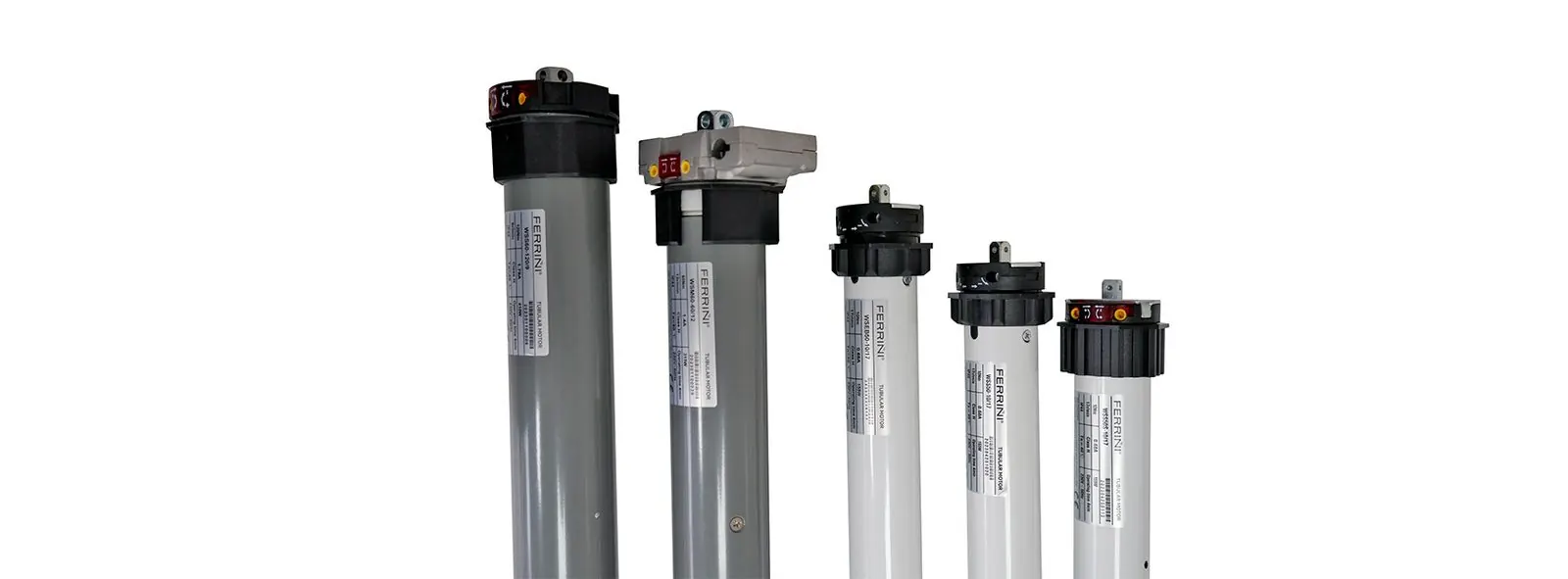
The fabric is part of the system’s performance as well. Outside the glass, a dark grey fabric reached a g tot of 0.08 and a white fabric 0.11 in a sector guide based on EN 14501, so choosing a darker fabric does not cost solar control [6]. The motor completes the system: Ferrini’s production records show that 98% of zip screens were motorised in 2025, and EN 12045 is the European standard for the safe use of motorised blinds [7].
Frequently asked questions
Which standard applies to zip screens sold in the EU?
Zip screens are covered by EN 13561, the European standard for external blinds; safety is part of its performance requirements, and it classifies resistance to wind [8]. In 2019 the EU extended those classes to the range 0–6 [9]. External blinds are placed on the European market with CE marking and a declaration of performance based on the harmonised standard [10, 11, 12], so importers should ask the manufacturer for that declaration and the classes it states.
Is a zip screen covered by the EU carbon border adjustment mechanism?
Customs classification follows a product’s main material, not its name [13]. The carbon border adjustment mechanism covers aluminium and iron and steel products, while plastics and textiles are outside its scope [14, 15]. A zip screen classified as a synthetic fabric article therefore falls outside it, whereas aluminium roller shutters, rolling shutters and window frames are covered [13, 16]. The obligation lies with the importer in the EU [16].
Sources
- Renson, Fixscreen 100 product page, undated page, accessed 02.10.2026. https://www.renson.eu/es-es/producten-zoeken/zonwering/screens/fixscreen/fixscreen-100
- ROMA KG, Wenn der Sonnenschutz mit der Pfosten-Riegel-Fassade verschmilzt: ROMA zipSCREEN F50 (press release), 12.10.2021. https://api.roma.de/presse/wenn-der-sonnenschutz-mit-der-pfosten-riegel-fassade-verschmilzt-roma-zipscreen-f50/55602/20211012_ROMA_KG_Presseinformation_zipSCREEN_F50_final.pdf
- Ediltecnico, Gibus S.p.A. firma profili, undated page, accessed 02.10.2026. https://ediltecnico.it/aziende/gibus-spa
- ROMA KG, ROMA ana sayfa and “About us”, undated page, accessed 02.10.2026. https://www.roma.eu/en/about-us
- ZENR, Roma is doing particularly well, 14.10.2019. https://zenronline.eu/en/general/roma-is-doing-particularly-well/
- ES-SO / Solskyddsförbundet, Solar shading for low energy buildings (with EN 14501 classification), 2012 (industry association publication). https://www.solskyddsforbundet.se/wp-content/uploads/2019/12/Solar-shading-for-low-energy-buildings.pdf
- CEN / Estonian Centre for Standardisation; Swiss Association for Standardization, EN 12045:2000 Power operated blinds and shutters – Safety in use; EN 1932:2013 External blinds and shutters – Resistance to wind loads, catalogue records, accessed 02.10.2026. https://www.evs.ee/en/evs-en-12045-2000
- CEN (European Committee for Standardization), CEN/TC 33, EN 13561:2015 External blinds and awnings; EN 13659:2015 Shutters and external venetian blinds – Performance requirements including safety, August 2015 (catalogue records). https://iteh.es/catalog/standards/cen/49186b1d-7c1a-4bbc-9a04-f83572642c33/en-13659-2015
- European Commission, Commission Delegated Regulation (EU) 2019/1188 – classes of performance for resistance to wind load of external blinds (EN 13561), OJ L, 12.07.2019. https://eur-lex.europa.eu/eli/reg_del/2019/1188/oj
- NLF Norm (Czech product regulation information system), EN 13659:2015 – harmonised standard record, undated page, accessed 02.10.2026. https://nlfnorm.cz/en/ehn/5124
- EUR-Lex, Commission Decision 1999/93/EC (attestation of conformity for doors, windows, shutters and blinds), 25 January 1999, accessed 02.10.2026. https://eur-lex.europa.eu/legal-content/EN/TXT/?uri=CELEX:31999D0093
- Genorma, EN 13561:2015 – External blinds and awnings, undated page, accessed 02.10.2026. https://genorma.com/en/standards/en-13561-2015/amp
- World Customs Organization (WCO), Harmonized System Nomenclature 2022 Edition, chapters 39, 63, 73 and 76, 2022. https://www.wcotradetools.org/en/harmonized-system/2022/fr/116306
- European Parliament and Council, Regulation (EU) 2023/956 establishing a carbon border adjustment mechanism, OJ L 130, 16.05.2023. https://eur-lex.europa.eu/legal-content/EN/TXT/HTML/?uri=CELEX:32023R0956
- European Commission, Commission Implementing Regulation (EU) 2025/2621 as regards the establishment of default values, 16.12.2025. https://eur-lex.europa.eu/legal-content/EN/TXT/HTML/?uri=CELEX:32025R2621
- European Parliament and Council, Regulation (EU) 2025/2083 amending Regulation (EU) 2023/956 as regards simplifying and strengthening the carbon border adjustment mechanism, OJ L, 17.10.2025. https://eur-lex.europa.eu/legal-content/EN/TXT/HTML/?uri=CELEX:32025R2083